Dry Needling
That muscle knot has a name. We needle it.
What Is Dry Needling?
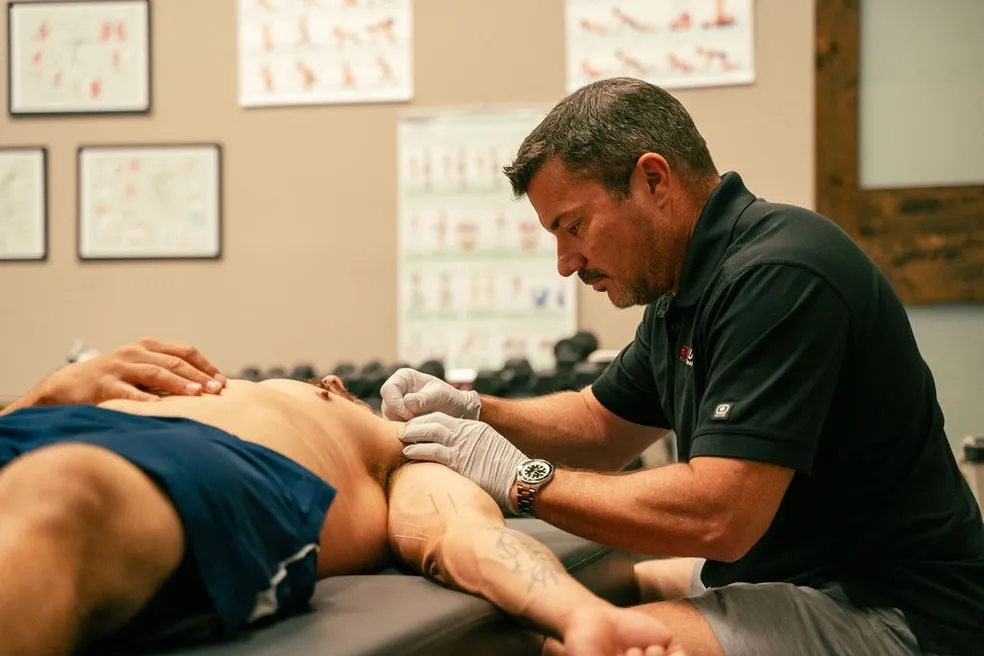
Dry needling is a clinical technique used by physical therapists and sports medicine providers to treat muscular pain and dysfunction. A thin, solid monofilament needle is inserted directly into a myofascial trigger point — a hyperirritable knot within a taut band of muscle tissue. The term “dry” simply means no medication or solution is injected. The needle itself is the therapeutic tool.
The goal isn’t to cause damage — it’s to create a precise, controlled disruption that prompts your body to heal.
How Dry Needling Activates Your Immune System
What makes dry needling more than just pain relief is what happens at the biological level. When the needle enters tissue, it triggers a sophisticated immune cascade — the same sequence your body uses to heal a wound.
The Local Inflammatory Response
The moment the needle penetrates tissue, your immune system responds immediately:
- Mast cells degranulate, releasing histamine, serotonin, and cytokines at the site
- Neutrophils — your body’s first responders — arrive within minutes to address the disruption
- Macrophages follow to clear debris and damaged tissue
This mirrors the early stages of healthy wound healing. Your body doesn’t distinguish between accidental injury and therapeutic needle insertion — it simply responds.
Cytokine Modulation: Resetting Chronic Inflammation
One of the most clinically significant effects of dry needling is what it does to inflammatory signaling molecules called cytokines:
- Needling reduces pro-inflammatory cytokines — including IL-1β, IL-6, and TNF-α — in tissue that has been chronically inflamed
- At the same time, it increases anti-inflammatory mediators that help resolve the inflammation
Chronic trigger points exist in a state of low-grade, persistent inflammation — essentially a loop that your body can’t exit on its own. Dry needling interrupts that loop by converting chronic, “stuck” inflammation into acute, resolvable inflammation that the body knows how to clear.
Macrophage Polarization: From Inflammation to Repair
Research suggests dry needling influences how macrophages behave after they arrive at the treatment site:
- M1 macrophages are pro-inflammatory — necessary in the acute phase
- M2 macrophages drive tissue repair, collagen synthesis, and resolution
The mechanical stimulation of the needle appears to shift macrophage activity toward the M2 repair phenotype — accelerating recovery and tissue regeneration rather than prolonging the inflammatory response.
The Neuromuscular-Immune Connection
Your muscles and immune system are in constant communication. Dry needling works at this intersection.
Substance P & CGRP: Quieting Neurogenic Inflammation
Trigger points release two key neuropeptides that amplify pain and inflammation:
- Substance P — increases local pain sensitization and inflammatory signaling
- Calcitonin Gene-Related Peptide (CGRP) — intensifies localized pain and vasodilation
Dry needling has been shown to reduce local concentrations of Substance P, directly calming the neurogenic inflammatory environment driving your symptoms.
The Local Twitch Response
If you’ve had dry needling, you may have felt — or seen — a brief, involuntary muscle contraction at the needle site. This is called a local twitch response (LTR), and it’s more than just a reflex:
- The LTR triggers a release of endogenous opioids, naturally reducing pain at the treatment site
- Studies show that trigger points are acidic environments — low pH actively inhibits healing and immune cell function
- The LTR and resulting increase in local blood flow (hyperemia) normalize tissue pH, creating the chemical conditions your immune cells need to do their job effectively
Dry needling works because it works with your biology — not around it. If you’re dealing with persistent muscle pain, movement limitations, or chronic tension that hasn’t responded to other treatments, this approach may be worth exploring.

Tired of treatments that never fix the real problem?